


14 March
10 min. read
Съдържание:

How many calories you burn daily depends on many factors such as weight,% body fat, age, physical activity, sex and more. However, it is possible by the use of special formulas to calculate the approximate value of the basal metabolism (BMR).
How to Find How Many Calories You Need?
To estimate the required daily energy for resting or so-called "basal metabolism", you will need some calculations.
Step #1: Calculate Subcutaneous Fat in Kilos
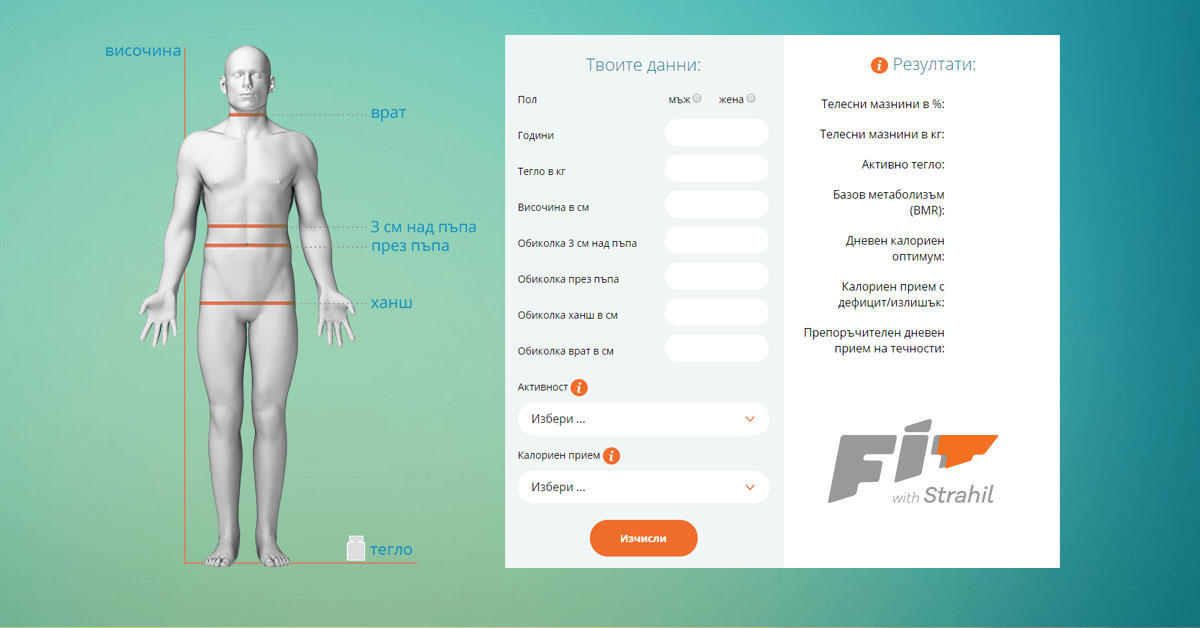
The first thing you need to do is to estimate the weight of your body fat. For this purpose you can use the following BMI calculator.
Step #2: Find Your Active Weight
The second thing you need to do is to estimate the active weight (body weight without fat). Take the value "subcutaneous fat in kilograms" from the BMI calculator and remove it from your weight in kilograms:
Active Body weight = weight in kg - Subcutaneous fat kg
Step #3: Find Your Basal Metabolic Rate
Third thing you need to do is to multiply your body weight by 22.5 = Basic metabolism at rest (Basal Metabolic Rate / BMR). These are the calories you need to maintain your current weight without any activity.
Here's an Example
Person X with the following data:
- Weight: 80 kg
- Height: 176 cm
- Waist: 83 cm
- Hips: 95 cm
Once we add this data in the calculator we get:
Subcutaneous fat in kilograms = 14.46 kg
Active body weight = Weight - Subcutaneous fat = 80 - 14.46 = 65.54 kg
Basal metabolism = Active weight * 22.5 = 65.54 * 22.5 = 1474.65 kcal
Step #4: Add Physical Activity
So far you know how many calories you burn if you have no physical activity. The next step is to take this factor into account. To do this you must use one of the following coefficients…
- If you live a sedentary lifestyle (little or no physical activity) - Daily calorie needs = BMR x 1.2
- If you are lightly active (light exercise / sports 1-3 days a week) - Daily calorie needs = BMR x 1.375
- If you are moderately active (moderate exercise / sports 3-5 days a week) - Daily calorie needs = BMR x 1.55
- If you are very active (strenuous exercise / sports 6-7 times a week) - Daily calorie needs = BMR x 1.725
- If you're extremely active (hard exercise / sports 6-7 times a week and physicaly loading work) - Daily calorie needs = BMR x 1.9
Assume that our guy go in the gym 3 times a week, but he has additional activity. He can easily take a factor of 1.55. Then:
BMPA (Basal metabolism with physical activity) = Basal metabolism (BMR) * Coefficient of activity = 1474.65 * 1.55 = 2285.7 kcal
These 2285.7 kcal provide the optimal calorie intake for our man. These are the calories he needs take daily in order to maintain his weight.
Step #5: Create a Calorie Deficit/Surplus
If the person "X" wants to raise or accordingly to reduce weight, he should increase or decrease his calorie intake. What I recommend for you is not to reduce or increase it too much your energy intake. When you reduce calories more than necessary, your metabolism can go into sleep mode. This means that your body will stop using fat for energy.
If you want to lose weight don’t reduce your calories by more than 25%. This is roughly the threshold at which the body still burns fat. If you're not sure what you are doing, don’t do experiments, because there are many other factors that need to be combined in your diet like physique, food and more.


