


17 March
5 min. read
Съдържание:

Fats are an integral part of every good food regimen. The most common mistake with of people who want to lose weight is to completely avoid fat consumption because of their high calorific value.
But I’ll tell you a secret: If you want to burn fats, eat fats (the right ones)! Fats are really important for your optimal health and take part in a lot of body functions. In this article you’ll learn which the healthy fats are, how they’re classified and how much of them you should consume.
“Good” Fats Explained
All fats are divided in the following two categories: saturated fatty acids and unsaturated fatty acids. Saturated fatty acids are in a solid or semi-solid state at room temperature. They’re found mostly in foods of animal origin such as milk and dairy products (butter, cheese and whipped cream), eggs, animal fats (especially in red meat). Saturated fatty acids are also found in tropical oils such as palm and coconut oil, dark chocolate and others. Unsaturated fatty acids are liquid at room temperature. Unsaturated fats can be further divided into monounsaturated and polyunsaturated fatty acids.
Monounsaturated Fatty Acids (MUFAs)
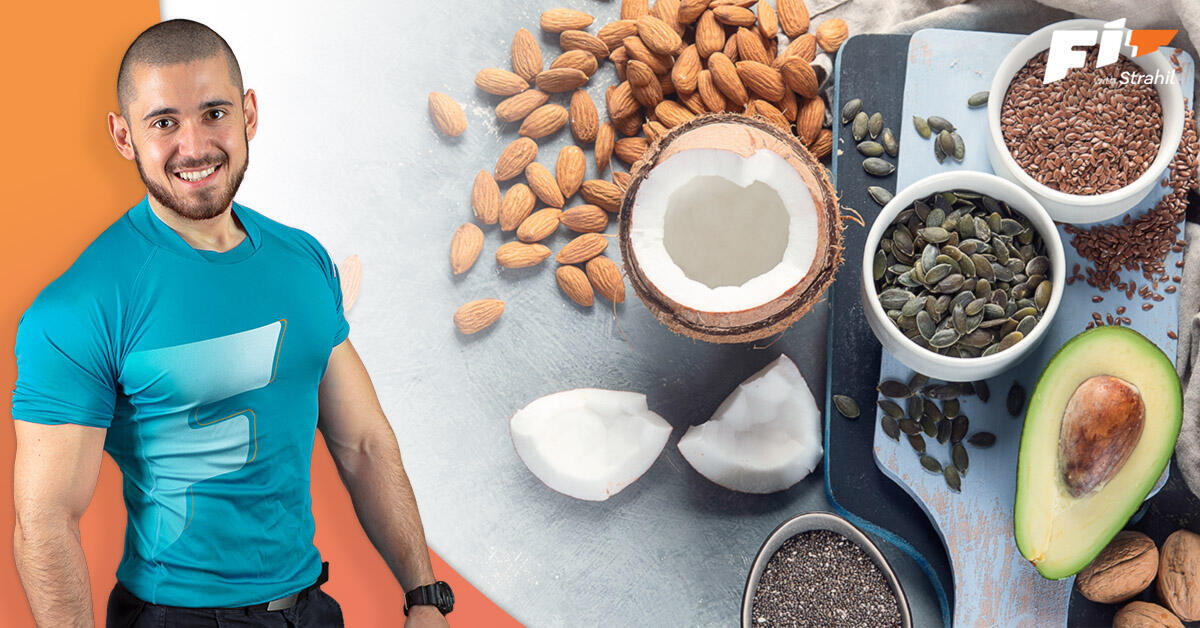
Found in avocados, nuts, olives and olive oil. Foods rich in these acids are good for lowering “bad” LDL cholesterol while at the same time keeping the “good” HDL cholesterol levels high. This is why monounsaturated fats are considered to be extremely healthy. Mediterranean diet - one of the healthiest diets in the world - is based on foods rich in monounsaturated fat. My advice is to eat half an avocado a day and 2-3 tablespoons of olive oil (extra virgin).
Polyunsaturated Fatty Acids (PUFAs)
Contained mainly in vegetable oils such as sunflower, corn, soybean, flax, hemp, rapeseed and others. Much of the fat in seafood is also polyunsaturated.
Polyunsaturated fatty acids are classified in two subgroups - omega-3 and omega-6. These fats are essential (indispensable), which means that are not synthesized by the body and must be obtained from food. Omega-6 are found primarily in vegetable oils (sunflower, corn, soybean, etc.), nuts and seeds. The modern diet provides us with a sufficient amount of omega-6 so it is not necessary to watch for their intake.
The best sources of omega-3 fatty acids are oily sea fish (salmon, sardines, herring), flax seeds and whose and walnuts. To get enough omega-3 fatty acids you have to be a little more creative. If you do not eat enough foods containing this essential fatty acids, discuss with your doctor their possible intake in the form of a dietary supplement - the most suitable are fish oil, krill oil, and flaxseed oil.
The Secret Is in the Ratio!
What many articles on the topic miss is that it is not only important to obtain adequate amounts of essential fatty acids, but to accept them in the correct ratio. Omega-6 fatty acids "compete" with omega-3 in the body and excessive intake of first can disrupt the absorption of the latter.
Ideally, the ratio of omega-6 to omega-3 should be between 1: 1 and 4: 1. Instead,in our contemporary diet we consume these essential fatty acids in ratios between 10: 1 and 25: 1, which means we are not able to derive the benefits of taking omega-3. Inflammatory processes begin in the body and this increases the risk of chronic diseases. Imbalance is due to excessive consumption of industrially processed foods and fats that actually contain all packaged foods. If you restore this balance, reduce your intake of omega-6 and increase your intake of omega-3 fatty acids, you will benefit from the long list of health benefits that rightfully belong to you.
But besides the numerous health benefits, what will the consumption of essential fatty acids contribute to achieve your goals? The answer is simple. The intake of essential fatty acids in optimal amounts (12-15% of daily calories) contribute to fat burning and increase metabolism.
Different Food Sources of Fat
|
Saturated fatty acids |
Monounsaturated fatty acids |
Polyunsaturated fatty acids |
|
Meat and meat products |
Olives and olive oil |
Salmon |
|
Milk |
Avocado |
Sardines |
|
Cheese |
Cashew |
Linseed |
|
Coconut oil |
Almonds |
Chia seeds |
|
Palm oil |
Hazelnut |
Hemp seed |
|
Cocoa oil |
Pistachios |
Walnuts |
How to Optimize Your Fats Intake?
For starters limit your intake of bad fats - completely eliminate trans fats and hydrogenated vegetable oils (contained in margarine and industrial pasta as croissants, muffins, etc.) Second, make sure that you get enough mono- and polyunsaturated fats. This will make you stronger and help you to get the figure you want.
Eat mostly fresh meat. Avoid highly processed meat products such as sausage, low-quality sausages and other sausages. Do not be afraid of good fats such as salmon, sardines and other oily fish, nuts, olive oil, coconut oil, linseed oil, avocados and olives, if they fit into your daily calorie limit. Replace the oil with olive oil (for salads and dressing) and natural coconut oil (for cooking). Try to balance your intake of omega-3 and omega-6 fatty acids. If you do not obtain enough essential fatty acids through food, you can use dietary supplements such as fish or flaxseed oil.
Avoid diets low in fat, but do not overuse them because of the high caloric content - experiment within 0.8-1 grams per kilogram of body weight. In percentage terms try to fit within 15-30% of daily calorie intake.


